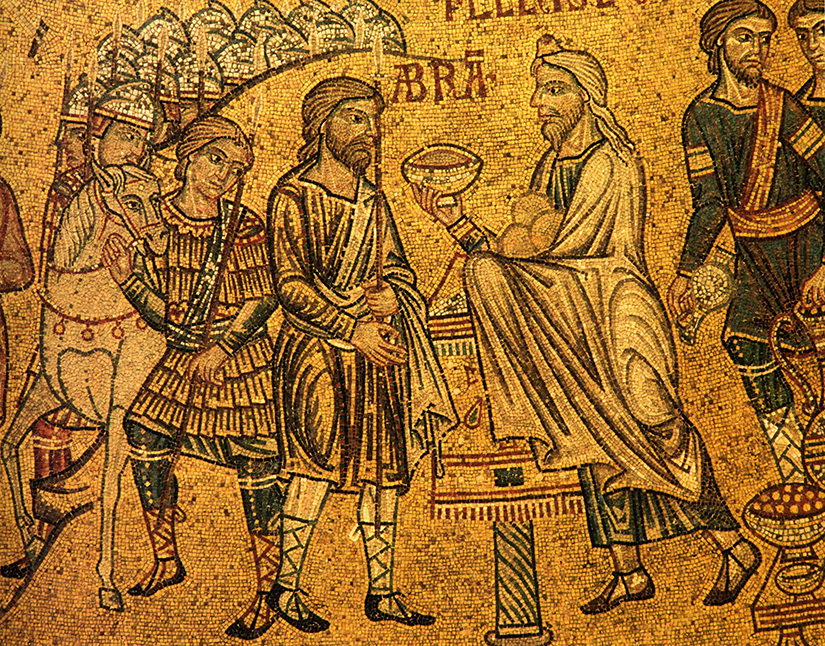

“After Abram returned from defeating Kedorlaomer and the kings allied with him, the king of Sodom came out to meet him in the Valley of Shaveh (that is, the King’s Valley). Then Melchizedek king of Salem brought out bread and wine. He was priest of God Most High, 19 and he blessed Abram, saying,
‘Blessed be Abram by God Most High,
Creator of heaven and earth.
And blessed be God Most High,
who delivered your enemies into your hand.’
Then Abram gave him a tenth of everything.” Gen 14:17-20(NIV84)
What an interesting person Melchizedek is in the scriptures! Abram heard about his nephew Lot being captured by the enemies of the Kings whose lands he’d decided to settle in. With 318 men, Abram pursued these enemies (“Kedorlaomer and the kings allied with him“), overtook them, and routed them to rescue his nephew Lot and incidentally also rescued food, supplies and people who were from Sodom. After the above blessing from the “King of Salem” (which also means, “King of Peace”) Abraham refuses any reward from the wicked King of Sodom and goes on his way and there are no other interactions recorded in the scriptures with Melchizedek. Melchizedek’s significance remained unknown for about two thousands years, save for what one could deduce from this interaction with Abram and what these scriptures say about him.

At this point in God’s relationship with man, there was no priestly covenant, there were not yet twelve tribes, and thus there were no “Levites” to serve as priests of the one true God. It is understood in Hebrew tradition that when we are blessed by someone, the greater blesses the lesser. It is also peculiar that the scriptures make it a point to note that he brought out bread and wine. The most interesting thing here is the bible’s assertion that Melchizedek “was priest of God Most High.” This is a validation of priesthood outside of Aaron’s descendants and there is no one else like Melchizedek who was noted as a priest of God Most High in the entire Torah – the “Old Testament.”
The book of Hebrews, addressing it’s eponymous audience, clarifies exactly what is going on here in Genesis 14 between Abram and Melchizedek. The Hebrews author crystallizes his significance to any one of us who’d strive to call on the name of the Lord Jesus Christ. To a Hebrew, the Levitical Priesthood was at the center of life and worship. The thought of anyone not of the priestly tribe offering sacrifices to God or laying claim to priesthood before Jehovah-God was not only offensive, but punishable by death according to the scriptures. There are several accounts in the scriptures of the sudden death of those who’d dare come and perform duties prescribed to only Aaron’s sons. For someone to lay claim to being a priest who was not of Aaron’s line was blasphemous.
This is what makes the following passage powerfully inspiring to some and grossly offensive to others:
“But you are a chosen people, a royal priesthood, a holy nation, a people belonging to God, that you may declare the praises of him who called you out of darkness into his wonderful light.” 1 Peter 2:9
Peter taught that disciples of Jesus were now a part of a Royal Priesthood. 1 Peter begins clarifying that the epistle addresses disciples of Jesus who are “…God’s elect, strangers in the world, scattered throughout Pontus, Galatia, Cappadocia, Asia and Bithynia…” 1 Peter 1:2. What a radical thought – that I am a Royal Priest as a disciple of Jesus! The book of Hebrews explains how this is by illuminating what happened in Genesis 14 between Abram and Melchizedek.
Heb 5:1-6
1 Every high priest is selected from among men and is appointed to represent them in matters related to God, to offer gifts and sacrifices for sins. 2 He is able to deal gently with those who are ignorant and are going astray, since he himself is subject to weakness. 3 This is why he has to offer sacrifices for his own sins, as well as for the sins of the people.
4 No one takes this honor upon himself; he must be called by God, just as Aaron was. 5 So Christ also did not take upon himself the glory of becoming a high priest. But God said to him,
“You are my Son; today I have become your Father.”
6 And he says in another place,
“You are a priest forever, in the order of Melchizedek.”
This is clarifying in that Jesus was a “priest forever, in the order of Melchizedek.” This reference is from the prophetic Psalm 110 verse 4. Not only was Jesus a priest in the order of Melchizedek, but the high priest. “Although he was a son, he learned obedience from what he suffered 9 and, once made perfect, he became the source of eternal salvation for all who obey him 10 and was designated by God to be high priest in the order of Melchizedek.” Heb 5:8-10 We learn here that in the new covenant, Jesus Christ is our high priest. It gets even deeper that that though! Later in Hebrews we learn that Jesus entered the very sanctuary of God – not the physical copy on earth in the temple or tent of the meeting, but the actual heavenly sanctuary on our behalf.
Heb 6:17-20
17 Because God wanted to make the unchanging nature of his purpose very clear to the heirs of what was promised, he confirmed it with an oath. 18 God did this so that, by two unchangeable things in which it is impossible for God to lie, we who have fled to take hold of the hope offered to us may be greatly encouraged. 19 We have this hope as an anchor for the soul, firm and secure. It enters the inner sanctuary behind the curtain, 20 where Jesus, who went before us, has entered on our behalf. He has become a high priest forever, in the order of Melchizedek.
What anchors my soul? What do I hope in? That my circumstances will improve? That I’ll be successful in something? What am I “greatly encouraged” by? Atonement in the old covenant for sins was accomplished outwardly by the priest entering the most holy place (a copy of the actual one in heaven) and offering a sacrifice on behalf of the people of God. Do I understand that Jesus went into the actual “most holy place” in the heavenly realm and offered himself, his own blood shed on the cross, for my sake – to make atonement for my sins?
The interaction in Genesis 14 between Abram and Melchizedek is brought to light here:
Heb 7:1-10
This Melchizedek was king of Salem and priest of God Most High. He met Abraham returning from the defeat of the kings and blessed him, 2 and Abraham gave him a tenth of everything. First, his name means “king of righteousness”; then also, “king of Salem” means “king of peace.” 3 Without father or mother, without genealogy, without beginning of days or end of life, like the Son of God he remains a priest forever.
4 Just think how great he was: Even the patriarch Abraham gave him a tenth of the plunder! 5 Now the law requires the descendants of Levi who become priests to collect a tenth from the people — that is, their brothers — even though their brothers are descended from Abraham. 6 This man, however, did not trace his descent from Levi, yet he collected a tenth from Abraham and blessed him who had the promises. 7 And without doubt the lesser person is blessed by the greater. 8 In the one case, the tenth is collected by men who die; but in the other case, by him who is declared to be living. 9 One might even say that Levi, who collects the tenth, paid the tenth through Abraham, 10 because when Melchizedek met Abraham, Levi was still in the body of his ancestor.

The concept of tithing did not originate from the Levitical priesthood. The concept of tithing came from Abram’s response to Melchizedek as he recognized him as a priest of God Most High. Abraham gave him a tenth of everything. It’s no wonder that as disciples of Jesus, we too offer a tenth of everything to our Lord, Jesus Christ, as he is the eternal high priest in the Order of Melchizedek. It’s strange to me that we’d quarrel or contend with the teaching of giving a 10th of everything seeing as our Lord is in the Order of Melchizedek.
If he is the eternal High Priest, then 1 Peter 2:9 is no longer offensive – we understand that we too are priests in the same order. There was the order of Aaron, the Levitical priesthood, and it could not bring perfection.

Heb 7:11-16
11 If perfection could have been attained through the Levitical priesthood (for on the basis of it the law was given to the people), why was there still need for another priest to come — one in the order of Melchizedek, not in the order of Aaron? 12 For when there is a change of the priesthood, there must also be a change of the law. 13 He of whom these things are said belonged to a different tribe, and no one from that tribe has ever served at the altar. 14 For it is clear that our Lord descended from Judah, and in regard to that tribe Moses said nothing about priests. 15 And what we have said is even more clear if another priest like Melchizedek appears, 16 one who has become a priest not on the basis of a regulation as to his ancestry but on the basis of the power of an indestructible life.
There is that eternal hope, there is than anchor for the soul, Jesus Christ’s life was indestructible! The priesthood changed and thus the law changed. What cemented Jesus’ high priesthood was his resurrection from the dead.
Heb 7:23-28
23 Now there have been many of those priests, since death prevented them from continuing in office; 24 but because Jesus lives forever, he has a permanent priesthood. 25 Therefore he is able to save completely those who come to God through him, because he always lives to intercede for them.
26 Such a high priest meets our need — one who is holy, blameless, pure, set apart from sinners, exalted above the heavens. 27 Unlike the other high priests, he does not need to offer sacrifices day after day, first for his own sins, and then for the sins of the people. He sacrificed for their sins once for all when he offered himself. 28 For the law appoints as high priests men who are weak; but the oath, which came after the law, appointed the Son, who has been made perfect forever.
In the old covenant, only the priest could enter the most Holy Place to intimately commune with God. He could also only come into this most Holy Place with blood from a sacrifice for his sins and the people’s sins. There was no deep connection with God. With Jesus as our high priest – this changes everything.

But those sacrifices are an annual reminder of sins, 4 because it is impossible for the blood of bulls and goats to take away sins.
Heb 10:11-14
11 Day after day every priest stands and performs his religious duties; again and again he offers the same sacrifices, which can never take away sins. 12 But when this priest had offered for all time one sacrifice for sins, he sat down at the right hand of God. 13 Since that time he waits for his enemies to be made his footstool, 14 because by one sacrifice he has made perfect forever those who are being made holy.
…
Heb 10:19-25
19 Therefore, brothers, since we have confidence to enter the Most Holy Place by the blood of Jesus, 20 by a new and living way opened for us through the curtain, that is, his body, 21 and since we have a great priest over the house of God, 22 let us draw near to God with a sincere heart in full assurance of faith, having our hearts sprinkled to cleanse us from a guilty conscience and having our bodies washed with pure water. 23 Let us hold unswervingly to the hope we profess, for he who promised is faithful. 24 And let us consider how we may spur one another on toward love and good deeds. 25 Let us not give up meeting together, as some are in the habit of doing, but let us encourage one another — and all the more as you see the Day approaching.
We enter the most holy place by the blood of Jesus Christ himself. When was the last time I’d considered my quiet time as “entering the most Holy Place” (aka “The Holy of Holies”), the very presence of God, as a “royal priest” in the order of Melchizedek? Do I have confidence in drawing towards God? The role of the priest in the Levitical priesthood was to intercede for the people and God through the prescribed sacrifices and cleansing rituals. As a royal priest in the order of Melchizedek, with Jesus Christ as our eternal high priest, our role is to be committed to the message of reconciliation. God makes his appeal through us! Is he able to make that appeal through me, or am I squelching his Spirit because I am taking for granted the hope I profess? What do I need to get open about so my heart can be sprinkled and cleansed by the blood of Christ? “But if we walk in the light, as he is in the light, we have fellowship with one another, and the blood of Jesus, his Son, purifies us from all sin.” – 1 John 1:7 Have I been committed to the message of reconciliation, serving as a royal priest in the Kingdom of God in the order of Melchizedek to a lost world – just like my Lord and Savior Jesus Christ? It’s time to get open and get close to God (James 5:16). Pray and realize that in that prayer, you are in the spiritual holy of holies, and be confident in your God and in the blood of Christ. Amen.