Latest QT’s

  • Honor Your Mother, Honor God

    Honor Your Mother, Honor God

    Amy with our two children, Dimitry and Paisley.  I'm grateful to teach our children to "Honor Your Mother!"
    Amy with our two children, Dimitry and Paisley. I’m grateful to teach our children to “Honor Your Mother!”

    Honor your father and your mother, as the Lord your God has commanded you, so that you may live long and that it may go well with you…” – Deut 5:16

    Mother’s day is such a wonderful opportunity to honor your mother.  We also should honor those in our lives who have mothered us.  Mother’s day is bittersweet for some of us because our mothers have passed away or we are estranged from them.  For those of us blessed to have our mother’s, we should reflect on this day with gratitude.  Jesus teaches in the scriptures that those who “God’s will” are his “brother and sister and mother.” (Mark 3:35)  The LORD also teaches that “everyone who has left houses or brothers or sisters or father or mother or children or fields for my sake will receive a hundred times as much and will inherit eternal life.” (Matthew 19:29) 

    In God’s kingdom, we can have a family that is deep, strong, and meets our needs.  Mother’s day is a day to honor both our physical mothers and our “spiritual” mothers “in the faith.”

    GOD COMFORTS LIKE A MOTHER

    As a mother comforts her child, so will I comfort you; and you will be comforted over Jerusalem.” (Isaiah 66:13)  God is tender.  When a woman is a good mother she’s an echo of this powerful part of our God.  He’s “close to the brokenhearted” and “saves those who are crushed in spirit.”  (Psalm 34:18)   God “heals the brokenhearted” and he “binds up their wounds.” (Psalm 109:16)  It is really hard to lose in life – or in anything, for that matter.  It is harder at times to admit losing in the first place.  Clearly, the reality that there is a great deal of pain in life not lost on the nature of God.  God wants to comfort us like a mother comforts her child. 

    When I was a child, I remember how my mother stayed up comforting me during the night when I had a severe earache.  I will never forget her tenderness.  We learn from the scriptures here that our God comforts tenderly like a mother. (Isaiah 49:13-16)

    WE NEED TO LOVE LIKE A MOTHER

    As apostles of Christ we could have been a burden to you,  but we were gentle among you, like a mother caring for her little children.  We loved you so much that we were delighted to share with you not only the gospel of God but our lives as well, because you had become so dear to us.  Surely you remember, brothers, our toil and hardship; we worked night and day in order not to be a burden to anyone while we preached the gospel of God to you.” (1 Thessalonians 2:6b-9)

    Paul, Silas, and Timothy wrote this letter to the congregation in Thessalonica.  (aka. Thessaloniki, Modern Greece)  They give us more qualities of what is “motherly” in a biblical sense. This scripture gives us a powerful example of how we are to love each other in God’s family.  Firstly, we are not to burden to those we are loving like a mother!  A loving mother is always inclined to give, to nurture, and to sacrifice for the needs of her children.  A mother works tirelessly on the everyday things we often take for granted.  For example, I’ve seen my wife and my mother both do the laundry, grocery shopping, cooking, cleaning, dishes, vacuuming…and a dozen other chores.  In short, these women meet the needs around them and do so through “toil and hardship” and they often work “night and day.

    Additionally, this example demands that we be “gentle among” each other “like a mother caring for her little children.” It’s important in principle to note that the scripture specifies “little children.”  Am I truly gentle like this in demeanor with my brothers and sisters in the church?  Am I gentle like this with my spouse and children?  When we see a little child there is a natural endearment and joy evoked by them.  As we age, in life and in the faith, it gets harder to hold this view of one another.  A felt need for respect replaces the real need for gentleness.  However, the Word of God calls us to give both to those around us!  (1 Peter 3:15)   

    Jesus teaches that such a “childlike” view is essential to inheriting the kingdom of God!  “He called a little child and had him stand among them.  And he said: I tell you the truth, unless you change and become like little children, you will never enter the kingdom of heaven.  Therefore, whoever humbles himself like this child is the greatest in the kingdom of heaven.” (Matthew 18:2-4)

    HAVE A MOTHER’S VISION

    In Matthew 20, James and John’s mother comes to Jesus and asks him boldly “Grant that one of these two sons of mine may sit at your right and the other at your left in your kingdom.” (Matthew 20:21)  She had a spiritual vision for her sons.  Many are concerned with a child’s success or even ensuring they are “doing what makes them happy.”  We can easily miss giving children deep spiritual aspirations and inspiring them to have a real, powerful, and truth-based love for God.  Compromise is the mother of dissension.  We all must decide if obeying Jesus and living by his standards is more important than worldly success.  Additionally, we must first decide to instill this conviction into ourselves, one another, and our children.

    A loving mother’s vision is that her children will do their very best in life.  God has this same kind of vision for his children.  “Whatever you do, work at it with all your heart, as working for the Lord, not for men, since you know that you will receive an inheritance from the Lord as a reward. It is the Lord Christ you are serving.” (Col 3:23-24)  A good mother also makes great plans for caring for her children both practically and in the future.  It sometimes takes tremendous planning to get to church early on Sunday mornings!  This is a very Godly heart to have, as God himself is a planner!  “For I know the plans I have for you,” declares the Lord, “plans to prosper you and not to harm you, plans to give you hope and a future.” (Jeremiah 29:11)

    HONOR YOUR MOTHER WITH OBEDIENCE

    Children, obey your parents in the Lord, for this is right.  ‘Honor your father and mother’ – which is the first commandment with a promise— ‘that it may go well with you and that you may enjoy long life on the earth.’” (Eph 6:1-3)  We honor our mother in the clearest fashion when we obey her.  Jesus honored Mary this way as a boy.  Luke 2:51 crystallizes this, “Then he went down to Nazareth with them and was obedient to them. But his mother treasured all these things in her heart.” 

    As a man, Jesus obeyed his mother by miraculously producing wine for the wedding in Cana when she told him “They have no more wine.” (John 2:3) This request was not on Jesus’ time.  He did not want to be involved.  We can see this from Jesus’ reply, “‘Dear woman, why do you involve me?’ Jesus replied. ‘My time has not yet come.’” (John 2:4)  Even still, the LORD honored his mother and met her request obediently!  And the LORD did not hold back in his obedience!  He created roughly 120-180 gallons of the best wine!

    HONOR YOUR MOTHER, BUT NEVER OVER GOD

    The only time we see Jesus disobeying his mother is when she, along with his brothers, try to stop him from doing God’s will.  The account of this in Mark highlights how Jesus’ family heard about a huge crowd gathering at the house he was staying in and then “went to take charge of him” as they had concluded that Jesus was “out of his mind.” (Mark 3:21)   When they arrive, they attempt to “take charge” of Jesus, sending someone into the crowd to tell Jesus, “Your mother and brothers are outside looking for you.” (Mark 3:32)  Jesus responds with “Who are my mother and my brothers?” (Mark 3:33)

    The Lord further clarifies exactly what he means while looking at those seated around him, saying “Here are my mother and my brothers!  Whoever does God’s will is my brother and sister and mother.” (Mark 3:33-35)  At this moment, Mary and Jesus’ brothers were not doing “God’s will” because they thought that Jesus was “out of his mind” and were trying to “take charge of him” while he was doing “God’s will!

    HONOR YOUR MOTHER, EVEN WHEN IT HURTS

    This interaction in Mark 3:21,33-35 was clarifying and yet certainly painful for Jesus’ mother, Mary.  However, it must be noted that Jesus honored his mother and called his most beloved disciple to honor his mother as his own while he suffered on the cross.  Even when we are in pain, even when we are suffering, we must imitate Jesus in how he honored Mary while he was suffering the agony of the cross.  “Near the cross of Jesus stood his mother, his mother’s sister, Mary the wife of Clopas, and Mary Magdalene.  When Jesus saw his mother there, and the disciple whom he loved standing nearby, he said to his mother, ‘Dear woman, here is your son,’  and to the disciple, ‘Here is your mother.’ From that time on, this disciple took her into his home.” (John 19:25-27) 

    Jesus’ example of honoring his mother while in excruciating pain had an eternal impact on Mary (and his brothers)!  Mary and Jesus’ brothers are among the faithful believers in Acts 1:14!  “They all joined together constantly in prayer, along with the women and Mary the mother of Jesus, and with his brothers.”  In the end, Mary became Jesus’ disciple as did his brothers.  Jesus’ two brothers, James and Jude, wrote their respective scriptural epistles!  Furthermore, Jesus’ brother James became the first leader of the central leadership council in Jerusalem. (Acts 15:15)  When we truly love God more than anyone and yet love everyone – the impact God will bring is undeniable!

    HONOR YOUR SPIRITUAL MOTHERS

    The Word of God highlights the need we have for spiritual mothers.  Paul writes in Rom 16:13, “Greet Rufus, chosen in the Lord, and his mother, who has been a mother to me, too.”  Amy and I have had many dear spiritual mothers over the years.  I’m so thankful for Elena McKean, Terese Untalan, Sharon Kirchner, Sonia Gonzalez, and many more who have been mothers to us.  We have many memories, battles, and treasured moments with these women that have defined us!  Their counsel and deep conversations during our times together healed and trained us.  I thank God for these valiant women of God who have been a mother to Amy and I, too. 

    Let us take time in prayer to thank God for our physical and spiritual mothers!  Let’s take time to reach out and remind them of the special place they have in our hearts!

    Jeremy Ciaramella
    Jeremy Ciaramella / Evangelist / phxicc.org


  • The Tongue And Its Power

    The Tongue And Its Power

    "The tongue has the power of life and death, and those who love it will eat its fruit." - Proverbs 18:21
    “The tongue has the power of life and death, and those who love it will eat its fruit.” – Proverbs 18:21

    Prov 6:16-19
    16 There are six things the Lord hates, seven that are detestable to him:
    17 haughty eyes, a lying tongue, hands that shed innocent blood,
    18 a heart that devises wicked schemes, feet that are quick to rush into evil,
    19 a false witness who pours out lies and a man who stirs up dissension among brothers.

    The Tongue’s Actions Determine God’s Feeling About Us

    One of the things I appreciate about my mother is that she had deep convictions about lying.  I would not get in too much trouble if I was honest about the what I did and the parties I went to.  If I lied though, mom would “lose it,” stiffen the penalties, and the punishment would often become double or more.  This is because lying to someone who loved me so much was very hurtful to them, and offensive to her, and she understandably took it very personally.  This disposition around lying stuck with me. Therefore, it has helped me understand God and personally connect to scriptures like this one.

    Most importantly, God emotionally and intensely reacts to me if I use my tongue to lie.  If I stir up people against each other or cause problems with my words God hates it.  The Hebrew word “sane’” here does really mean “to hate (personally).”  The Hebrew word translated as “detestable” here is “tow`ebah, and means “a disgusting thing, an abomination.”  God takes how I speak very personally. It’s because his love is so deep that he cares this much about what comes out of our mouths.  Love always “rejoices with the truth” (1 Corinthians 13:6) and God is love” (1 John 4:8), therefore this intense reaction from God makes sense.

    Prov 6:23-24
    23 For these commands are a lamp, this teaching is a light, and the corrections of discipline are the way to life, keeping you from the immoral woman, from the smooth tongue of the wayward wife.

    The Tongue’s Powers Must Be Protected Against

    The best defense we have against someone using their tongue to seduce or entice us to sin are the commands of God.   Besides, if we spend time filling ourselves up with God’s word, when (not “if”, but when) we are enticed by a “smooth tongue,” we’ll be prepared.  A “smooth tongue” is contrasted here with the commands of God.  The “smooth tongue” being darkness and “leading down to the chambers of death” (Proverbs 7:27).  The commands of God being “a lamp,” a “light,” and “the way to life.”  Who am I going to listen to?  Sometimes my own “self-talk” from my heart and thoughts is dark and would lead me to death, persuaded to sin, and disbelief.  How can “take captive every thought to make it obedient to Christ?” (2 Corinthians 10:5)

    Consequently, the biblical way to keep myself pure and to guard my steps like this is to memorize the scriptures and having them “hidden…in my heart.” :

    Ps 119:9-11
    9 How can a young man keep his way pure? By living according to your word.
    10 I seek you with all my heart; do not let me stray from your commands.
    11 I have hidden your word in my heart that I might not sin against you.

    Prov 10:19-20
    19 When words are many, sin is not absent, but he who holds his tongue is wise.
    20 The tongue of the righteous is choice silver, but the heart of the wicked is of little value.

    The Tongue Can Be Used Too Much

    Clearly, we see all of us can choose to use our tongue to lie, to entice, and to seduce.  Furthermore, we can use our tongue simply too much – by talking more than is necessary. The scriptures teach us “when words are many” there is some kind of sin we are covering for.  Rationalizing, excuse-making, and deceiving all take more words to make work than the truth.  The scriptures caution us “A gossip betrays a confidence, so avoid a man who talks too much.” (Proverbs 20:19)  I need to make sure that I am not that man who uses words to manipulate and defend himself.  I can often over-explain which comes from insecurity, which can come from a lack of faith, or a self-focus, or a troubled conscience.  Finally, it’s important for me, and all of us, to identify whatever is causing us to use “many words” when this comes up.

    The heart of the righteous weighs its answers, but the mouth of the wicked gushes evil. (Proverbs 15:28)
    The heart of the righteous weighs its answers, but the mouth of the wicked gushes evil. (Proverbs 15:28)

    Similarly, this “economy of words” is something the ancient Spartans famously demonstrated in their culture.  “Lakonia” is the name of the ancient region of Greece in the southeastern part of the Peloponnese peninsula.  This region’s capital was (and still is) the city of Sparta. The word “laconic,” has come to mean both from this region and to thoughtfully use the least amount of words possible.  Such was the practice of the ancient Spartans. Another thing I find is that the truth takes much fewer words and makes for a lighter heart and clearer head. Most importantly, it also brings me into fellowship and closeness with those around me and gets me in touch with grace – both given and received. (1 John 1:5-10)

    Prov 17:28
    28 Even a fool is thought wise if he keeps silent, and discerning if he holds his tongue.

    The Tongue Speaks What The Heart Is Full Of

    What will I use my tongue for today?  How will it affect God’s view of me? How will it affect those around me?  What does it indicate about my own heart? Jesus said, “for the mouth speaks what the heart is full of.” (Luke 6:45)  What will I fill my heart with today and what impact will it have?  What will it bring forth from my heart – wisdom or perversity, a piercing sword or healing?  Consequently, will it help me endure forever…or only last a moment?

    Prov 10:31
    31 The mouth of the righteous brings forth wisdom, but a perverse tongue will be cut out.
    Prov 12:18-19
    18 Reckless words pierce like a sword, but the tongue of the wise brings healing.
    Prov 11:12,19
    12 A man who lacks judgment derides his neighbor, but a man of understanding holds his tongue.
    19 Truthful lips endure forever, but a lying tongue lasts only a moment.

    Dare I speak the truth from my heart, good or bad? Even more, will I get in touch with where I actually am in my relationships – with God and with others?  Or will I decide to “gush folly” and avoid the issues? There is no hope in a deceitful tongue. Additionally, there is no healing in a deceitful tongue, only crushing my spirit – and others!

    Prov 15:2
    2 The tongue of the wise commends knowledge, but the mouth of the fool gushes folly.
    Prov 15:4
    4 The tongue that brings healing is a tree of life, but a deceitful tongue crushes the spirit.
    Prov 17:20
    20 A man of perverse heart does not prosper; he whose tongue is deceitful falls into trouble.

    The Tongue That Deceives

    A deceitful tongue is the result of a perverse heart.  When I’ve made the conscious decision to lie, it was always to get ahead.  Often, I wanted something for nothing and acted selfishly.

    As a result, when I was a teenager I stole some chips capriciously from the storefront display at the corner convenience store.  I lied when I got caught, saying that I thought the friend with me had paid for the chips when he went to the counter. I recall another moment when lied to my jazz guitar teacher, saying I was so broke I could not afford gas that week and could I pay him later.  He shrewdly exposed me and I’ll never forget the look on his face when he realized I was trying to take him for 20$. That was the price deceit and selfishness put on that friendship. Please forgive me, Eric. Certainly, even if I would have made a fortune, it would never be worth it!  “A fortune made by a lying tongue is a fleeting vapor and a deadly snare.” (Proverbs 21:6)

    Prov 26:28
    28 A lying tongue hates those it hurts, and a flattering mouth works ruin.
    Prov 16:1
    To man belong the plans of the heart, but from the Lord comes the reply of the tongue.
    Prov 17:4
    A wicked man listens to evil lips; a liar pays attention to a malicious tongue

    The Tongue That Replies Well

    Furthermore, God can guide me to reply well.  I can pray to him for help, for guidance, for an apt and wise reply.  I can listen to his word, his “lips,” and avoid my own self-deception.  Sometimes the most malicious tongue is my own, tearing me down in my head, and it is wicked to listen to that inner voice of self-doubt in my heart!  This is a choice I make! I must instead decide to listen to the Lips of God, the Word of God, and put its truth in my head and heart! “I reach out for your commands, which I love, that I may meditate on your decrees.” (Psalm 119:48)  “Oh, how I love your law! I meditate on it all day long.” (Psalm 119:97)  What will I meditate on?  Whose lips shall I listen to?

    My son, if you accept my words and store up my commands within you,  turning your ear to wisdom and applying your heart to understanding,  and if you call out for insight and cry aloud for understanding, and if you look for it as for silver and search for it as for hidden treasure, then you will understand the fear of the Lord and find the knowledge of God. (Prov 2:1-5)
    My son, if you accept my words and store up my commands within you, turning your ear to wisdom and applying your heart to understanding, and if you call out for insight and cry aloud for understanding, and if you look for it as for silver and search for it as for hidden treasure, then you will understand the fear of the Lord and find the knowledge of God. (Prov 2:1-5)

    Prov 25:15
    15 Through patience a ruler can be persuaded, and a gentle tongue can break a bone.
    Prov 25:23
    23 As a north wind brings rain, so a sly tongue brings angry looks.
    Prov 28:23
    3 He who rebukes a man will in the end gain more favor than he who has a flattering tongue.
    Prov 31:26
    26 She speaks with wisdom, and faithful instruction is on her tongue.

    The Tongue Can Heal, Endure, And Wisely Instruct

    The tongue can be used for many things.  It has all manner of incredible power in our lives and the lives of those around us.  The tongue can be deceitful, persuasive, sly, flattering, smoothly seductive, and in its gentleness, even break bones!  Incidentally, according to the bible, it is not sticks and stones that break bones – it is the words spoken by a gentle tongue!  The tongue can commend knowledge and bring healing! It can help one endure forever and bring forth faithful instruction and very the wisdom of God!

    The scriptures are true –
    “The tongue has the power of life and death, and those who love it will eat its fruit.” (Proverbs 18:21)

    Finally, may all of us love the tongue, and “[speak] the truth in love, sowe will grow to become in every respect the mature body of him who is the head, that is, Christ.” (Ephesians 4:15) To God be the Gory!

    Jeremy Ciaramella
    Evangelist,
    Phoenix International Christian Church

  • What Do Righteous and Righteousness Mean?

    What Do Righteous and Righteousness Mean?

    "The wicked flee though no one pursues, but the righteous are as bold as a lion." - Proverbs 28:1
    “The wicked flee though no one pursues, but the righteous are as bold as a lion.” – Proverbs 28:1

    What do righteous and righteousness really mean?  What does it mean to be a “righteous person?”  Who is highlighted as a “righteous person” in the scriptures and why?  Or, most importantly, how can we be righteous in the eyes of God?  If I follow all the right rules will I be righteous?  Is it about duty?  Is it about heart?

    The word “righteous” appears twenty-four times in the four gospels. It appears one time in the gospel of John, two in Mark, six in Luke, and fifteen in Matthew.  Mark’s gospel does not use the word “righteousness” at all.  Luke’s and John’s gospels only mention “righteousness” twice in each of theirs.  However, “righteousness” appears seven times in the gospel of Matthew.  Because the gospel of Matthew has these words used more than any of the other gospels we’ll start our study there.

    Blessed are those who act justly, who always do what is right. - Psalm 106:3
    Blessed are those who act justly, who always do what is right. – Psalm 106:3

    Someone Who Does What Is Righteous

    The first time “righteous” appears in the gospel of Matthew is in Matthew 1:19.  “Because Joseph her husband was a righteous man and did not want to expose her to public disgrace, he had in mind to divorce her quietly.”  The Greek word for “righteous” used here is “dekaios.”  The base root word is “dikē” which means “custom” or “just.”  This root word came to denote “what is right” (c.f. Vines).  “Dekaios” is used to describe someone who observes these “rules”, “customs”, and does “what is right.”  

    1 John 3:7 sums up this idea.  “Dear children, do not let anyone lead you astray.  The one who does what is right is righteous, just as he is righteous.”  The word for “righteous” here is “dikaiosynē” and it’s root word is “dekaios” which we’ve discussed previously.  The scriptures utilize this word “dikaiosynē” in the following ways*:

    1. in a broad sense: state of him who is as he ought to be, righteousness, the condition acceptable to God
      1. the doctrine concerning the way in which man may attain a state approved of God
      2. integrity, virtue, purity of life, rightness, correctness of thinking feeling, and acting
    2. in a narrower sense, justice or the virtue which gives each his due

     *blueletterbible.org

    Righteousness Means You Do What Is Merciful

    Joseph did what was right and did not expose Mary to public disgrace.  Joseph could have made her pregnancy known and would have been within his rights to do so.  This would have disgraced Mary and the child she was carrying.  Furthermore, the scriptures commanded that a woman who lied to man about her virginity was to be stoned to death at the door of her father’s house. (Deuteronomy 22:20-21)  Joseph was being merciful in his actions.  He did not know what to believe in this situation and yet he handled it “righteously.”  Joseph did not lash out.

    We must ask ourselves if we lash out when it is within our power, our opportunity, our even our “rights.”  Certainly, Joseph’s heart was broken and the scriptures called for punishment.  Despite all this, he did what was righteous and was merciful.  When our hearts are broken or we suffer injustices at the hands of those we’ve trusted – will we be merciful like him?  Will I thirst for vindication or for grace?  Shall I put my hope in rectification or in the mercy of God?  Do we desire the satisfaction of a justly delivered punishment or the homecoming of forgiveness?  (Luke 15:11-24)  God always allows us our choice of what we will hunger and thirst for.

    The Righteous Will Shine

    “As the weeds are pulled up and burned in the fire, so it will be at the end of the age.  The Son of Man will send out his angels, and they will weed out of his kingdom everything that causes sin and all who do evil.  They will throw them into the fiery furnace, where there will be weeping and gnashing of teeth.  Then the righteous will shine like the sun in the kingdom of their Father. He who has ears, let him hear.” (Matthew 13:40-43)

    This passage is very sobering.  We can be in the kingdom and be causing sin and doing evil!  Therefore, people can look saved but be destined to have angels “throw them into the fiery furnace!”  We can cause each other to sin even when our sin is not “public.”  We can think that because our sin is “private” it is not hurting anyone else.  I believed this lie myself in the mid-late 90’s.  During this time I struggled with gross impurity almost weekly for a couple of years.   Additionally, I numbed my heart to the thought that it affected anyone else because I committed the sins in “private.”

    “Be on your guard against the yeast of the Pharisees, which is hypocrisy." - Luke 12:1
    “Be on your guard against the yeast of the Pharisees, which is hypocrisy.” – Luke 12:1

    Un-Righteous Yeast Affects The Whole Body of Christ

    The Holy Spirit through Paul the Apostle asks “Don’t you know that a little yeast works through the whole batch of dough?” (1 Corinthians 5:6)  The Word of God teaches “you must not associate with anyone who calls himself a brother but is sexually immoral or greedy, an idolater or a slanderer, a drunkard or a swindler. With such a man do not even eat.” (1 Cor 5:11)  The Holy Spirit through Paul lists here sexual immorality, greed, idolatry, slandering, drunkenness, and swindling in this passage.  These kinds of sins are the yeast that will infect “the whole batch of dough.”  If we are going to overcome this, we must confess and renounce our sins.  Then we will be righteous and shine like the sun.

    I remember the profound effect memorizing the first and second chapters of the book of 1st John had on my mind and heart.  I spent several months in 1999 memorizing these two chapters of the bible.  By God’s grace and faithfulness, He placed in my life two amazing disciples of Jesus who “discipled” me consistently and firmly with God’s word.  At first, I was critical, petty, proud, arrogant and hard-hearted.  This is because I resented the sharp truths presented to me from the scriptures by this dear brother.  To my shame I was numbed by sin and enslaved to pride.  It is to God’s glory and through his grace alone my character was shaped, my heart freed, and my mind changed.  Darren  Christina, you will forever have my deepest gratitude.

    Confession Is The Key To Being Righteous

    He who conceals his sins does not prosper, but whoever confesses and renounces them finds mercy.” (Prov 28:13)

    The main point in this scripture is finding mercy by confessing and renouncing sin.  We certainly can’t find something we are not even looking for.  In the past, I’ve confused finding mercy with self-worth and self-validation.  I’ve thought and wrestled with my worth, my significance, coming from “my impact” or “my accomplishments” in the ministry in particular.  In retrospect, this skirts mercy and grace altogether because these are given, not earned by works or merits.  I’m already priceless to God, and I confess my sins because of that.  I trust that God is who he says he is, and he hears my cries for mercy.  

    The main principle in 1st John 1:5-10 is similar to Proverbs 28:13.  We are called to “walk in the light” because “God is light; in him there is no darkness at all.”  The author of 1 John is the beloved apostle John who also wrote the Gospel of John.  We can understand better what John means here in 1st John 1:5-10 by looking at what he wrote about “light” in John 3:19-21.  “Everyone who does evil hates the light, and will not come into the light for fear that their deeds will be exposed.”  (John 3:20)  When we are transparent and confess our sins (walk in the light, as “he is in the light”) our evil deeds are exposed.  Then, according to the promises in 1 John 1:5-10, “the blood of Jesus, [God’s] Son, purifies us from all sin.

    "...The righteous will shine like the sun in the kingdom of their Father." - Matthew 13:43
    “…The righteous will shine like the sun in the kingdom of their Father.” – Matthew 13:43

    Our Righteousness Is From God’s Mercy

    …confess your sins to each other and pray for each other so that you may be healed. The prayer of a righteous person is powerful and effective.” (James 5:16)  We will be made righteous by Jesus’ obedience. (Romans 5:19)  Jesus humbled himself and “became obedient to death – even death on a cross!”  (Philippians 2:8)  Our responsibility is to own our sin, to confess it, to renounce it and repent of it.  

    You see that a person is considered righteous by what they do and not by faith alone.  In the same way, was not even Rahab the prostitute considered righteous for what she did when she gave lodging to the spies and sent them off in a different direction?  As the body without the spirit is dead, so faith without deeds is dead.”  (James 2:24-26)

    May we find righteousness not in ourselves, but in Christ.  I pray I remember God’s grace, and allow it to teach me to say “no” to my worldliness and ungodly passions.  (Titus 3:12) I pray that grace will inspire me to walk in the light, to confess my sins plainly, so that whatever “righteousness” I do or have is shown as being done “through God.”  (John 3:21)

  • Clinging Like Jesus

    Clinging Like Jesus

    The Angels Heralded Jesus' Birth! Many were clinging to the prophecy of Christ's arrival!
    The Angels Heralded Jesus’ Birth! Many were clinging to the prophecy of Christ’s arrival!

    Then Jesus told them, “This very night you will all fall away on account of me, for it is written:

    “‘I will strike the shepherd, and the sheep of the flock will be scattered.’

    But after I have risen, I will go ahead of you into Galilee.”  Peter replied, “Even if all fall away on account of you, I never will.”  “I tell you the truth,” Jesus answered, “this very night, before the rooster crows, you will disown me three times.”  But Peter declared, “Even if I have to die with you, I will never disown you.” And all the other disciples said the same.  (Matthew 26:31-35)

    God’s Greatest Gift To Us

    Jesus is quoting Zechariah 13:7 here in Matthew 26:31.  There are a great deal of references to Jesus in the context of Zechariah 12 and 13.  Zechariah was a Levite born in Babylon and prophesied as a contemporary to the Prophet Haggai, Zerubbabel, and Joshua the High Priest (in the early 6th century BC).  Jesus’ quoting of this passage in Zechariah helps us understand that its surrounding context holds prophetic significance regarding Jesus.  For example, in Zechariah 12:10 the prophet wrote:

    “And I will pour out on the house of David and the inhabitants of Jerusalem a spirit of grace and supplication. They will look on me, the one they have pierced, and they will mourn for him as one mourns for an only child, and grieve bitterly for him as one grieves for a firstborn son.

    We know that Jesus was God’s greatest gift to us as explained John 3:16, “For God so loved the world that he gave his one and only Son, that whoever believes in him shall not perish but have eternal life.”  We also know that Jesus’ blood was shed to cleanse us from our sins, “How much more, then, will the blood of Christ, who through the eternal Spirit offered himself unblemished to God, cleanse our consciences from acts that lead to death, so that we may serve the living God!” (Heb 9:14)

    We see here in Zechariah 12:10 that God planned all along to pour out a spirit of grace through his “one and only” son’s suffering on the cross!  Jesus precisely and deliberately quoted a scripture in a context that said a lot about him.  None of us can outgive God!  God has given us “…life and breath and everything else!” (Acts 17:25)  God’s greatest gift was his “firstborn son!”  God gave us “a spirit of grace and supplication” through his “only son.” (Zechariah 12:10)

    Clinging To The Scriptures

    Jesus explained to all of them candidly that they would desert him.  He starts by telling them plainly – “You will all fall way on account of me” (Matthew 26:31)  Then Christ quotes this passage in Zechariah 13:7 which explains why.  He quotes other scriptures and references their fulfillment throughout his crucifixion.  Jesus was clinging to the scriptures throughout the passion.  He had them on his heart and mind at each step he took towards the cross.  (Matthew 26:24,54,56)  Jesus was quoting the scriptures even while he was on the cross itself! (Matthew 27:46, Psalms 22)

    On the other hand, his disciple Peter was emotional and vehemently rejected the notion that he would ever deny Jesus.  Peter said “Even If I have to die with you, I will never disown you.” (Matthew 26:35)  Peter and the other disciples are understandably clinging to their emotions.  It would be emotionally difficult to understand Jesus’ statement about them deserting him.  It’s in our (sinful) nature to go with our heart, with our “gut-feeling”, or our sentiments.  We must cling to the scriptures just as Jesus did when we are confronted with our crosses to bear (1 John 2:6).

    Clinging To The Scriptures Like Jesus Did
    Clinging To The Scriptures Like Jesus Did!

    There are all kinds of trails in our lives and we will find ourselves clinging to something during those times.  When I am not clinging to the scriptures I cling to myself, my children, my wife and even my vocation.  When I’ve clung to myself, I’ve “checked-out.”  I find myself indulging in gaming, Youtube, Netflix and the like.  In these moments I’m just doing what makes my flesh “feel-good.”  In clinging to myself I’ve focused on myself and serving myself.  “do not use your freedom to indulge the flesh; rather, serve one another humbly in love.” (Galatians 5:13) I’m grateful the scriptures teach me how to repent when I am clinging to myself – “Serving one another humbly in love!

    Personal Trials

    In 2009 Amy and I had to spiritually and emotionally navigate being taken out of the full-time ministry and out of our role as overseers for our beloved Eugene International Christian Church. We moved to Los Angeles to be with the church there and to get some much needed spiritual perspective.  I went back into the IT field working at various jobs.  It was very challenging at first, as we’d short-sold our home in Eugene and the credit union began to initiate legal action against us for the 57,000$ difference.  I had just lost my job in the ministry at this point.  Then I found a position as a programmer in LA shortly thereafter.  Unfortunately, I’d made some very poor choices at this new job and so made very little money.  After all of this, we filed for bankruptcy in 2009.

    God blessed me with a couple of other opportunities after these events.  Additionally, I was learning some hard lessons about how independent and prideful I was at each job in spite of these blessings.  During these challenging times when I found myself clinging to the scriptures I was at peace, able to accept God’s discipline and God’s plan.  Conversely, When I clung to myself or my job, I felt the distance between me and my wife and children.  I had a short-temper and was incredibly ungrateful during these times.  I had no peace.  (Psalms 119:165-168)

    Sincerely Vulnerable

    Jesus was remarkable in that he was vulnerable with his closest three disciples even though they did not warrant such trust from him.  So often we seek those in our lives to be “trustworthy” before we trust them with the true depths of our hearts.  We must come to clarity on this disposition being nothing like Jesus’ at all.  Therefore, we must “always trust” (c.f. 1 Cor 13:7) in our relationships in order to truly follow Jesus (and be his disciple)!  Jesus trusted Peter, James and John so much he revealed to them his heart “My soul is overwhelmed with sorrow to the point of death” (Matthew 26:38).  Furthermore, Jesus humbly asked them “Stay here and keep watch with me” (Matt 26:38).  The reason Jesus was able to trust these imperfect, weak, and struggling disciples with his true heart was because he knew he would soon be clinging to prayer.

    Clinging To Prayer

    In addition to imitating Jesus’ example of clinging to the scriptures, we must imitate his example of clinging to prayer.  Oddly enough, this disposition made Jesus willingly vulnerable and trusting to the same men who professed to die with him and yet would betray him that same night.  It’s tempting to think that what is in our hearts is “between us and God.”  The scriptures and Jesus’ example do not endorse such a mentality in any of us.  While honest vulnerability is never a replacement for clinging to prayer, this kind of transparency shows integrity and a sincere reliance on God.

    Consider 1 Corinthians 12:26: “If one part suffers, every part suffers with it; if one part is honored, every part rejoices with it.”  How can we suffer with one another if we are not sharing our hearts as Jesus did with one another?  If we are ignorant and closed off to each other’s hearts we cannot pray for one another to “be healed!” (James 5:16)

    Clinging to Prayer like Jesus did!
    Clinging to Prayer like Jesus did!

    Often we use past “church hurts” or relational injuries as a justification to withhold trust from others.  We can also deliberately test the trust of those around us because of this.  We’re constantly looking to discredit the sincerity of those around us in our “hurt” and fail to see the simple solution of forgiving before us.  Men deceived by the emotions they were clinging to surrounded Jesus at this time in his life.  And yet Jesus was merciful to them and gave them the benefit of the doubt even when he knew they would let him down and when they fell asleep watching over him! (c.f. Matt 26:40-41)

    A Powerful Principle and Stunning Truth

    Early on in Jesus’ ministry he taught them this principle of mercy with one another.  Peter asked Jesus in Matthew 18:21 “Lord, how many times shall I forgive my brother when he sins against me? Up to seven times?” The Lord replied, “I tell you, not seven times, but seventy-seven times.” (Matt 18:22)  It’s worth noting that immediately after this teaching Jesus preaches one of the most intense parables in the scriptures about the “unmerciful servant.”  This parable concludes with a stunning teaching!

    “Shouldn’t you have had mercy on your fellow servant just as I had on you?’ In anger his master turned him over to the jailers to be tortured, until he should pay back all he owed.  “This is how my heavenly Father will treat each of you unless you forgive your brother from your heart.” (Matt 18:33-35)

    When we imitate Jesus we will find ourselves clinging to prayer.  When we do so we will have the strength to lovingly trust others with our heart-of-hearts. Let us never confuse shrewdness for mistrust nor mistrust for wisdom.  Instead, we must cling to prayer when we are faced with tough circumstances, relationships, and issues.  “During the days of Jesus’ life on earth, he offered up prayers and petitions with loud cries and tears to the one who could save him from death, and he was heard because of his reverent submission.”  (Hebrews 5:7-8)

    Clinging To Jesus, The Perfect Model

    At the end of the day, we need to look to God’s ultimate gift to us, his one and only son Jesus Christ.  Jesus is our model and our hope and who we should be clinging to.  Jesus Christ is the reason for the season.  His examples of clinging to the scriptures, being sincerely vulnerable, and clinging to prayer are the ones we must cling to!  We will be strengthen when we cling like Jesus! We will be able to weather any storm and pick-up any cross we are called to!  Following Christ is an astonishing adventure and clinging like Jesus prepares us for it!

    To God be the glory –

    Jeremy Ciaramella
    Jeremy Ciaramella


  • Reflecting On 2 Timothy 2:1-7

    Reflections On 2 Timothy 2:1-7
    “Reflect on what I am saying, for the LORD will give you insight into all this.” 2 Timothy 2:7

    2 Timothy 2:1-7

    You then, my son, be strong in the grace that is in Christ Jesus. 2 And the things you have heard me say in the presence of many witnesses entrust to reliable men who will also be qualified to teach others. 3 Endure hardship with us like a good soldier of Christ Jesus. 4 No one serving as a soldier gets involved in civilian affairs — he wants to please his commanding officer. 5 Similarly, if anyone competes as an athlete, he does not receive the victor’s crown unless he competes according to the rules. 6 The hardworking farmer should be the first to receive a share of the crops. 7 Reflect on what I am saying, for the Lord will give you insight into all this.
    This is an incredible payload of teaching and training for Timothy.  Paul says we should “reflect” on what he is saying here.  This is exactly what we are going to do line-by-line.  This is a break-down of what Paul thinks of ministry.  Both Paul and Timothy what we’d consider were full-time ministry leaders and oversaw churches. (Special thanks to Tim Kernan for sharing this lesson with the Phoenix International Christian Church staff and house church leadership groups.)

    Be Strong In The Grace (2 Timothy 2:1)

    You then, my son, be strong in the grace that is in Christ Jesus.
    If I don’t feel forgiven (e.g. “strong in the grace”) then how can I help someone else feel strong in it?  Someone who is “strong in the grace” works hard.  Paul said himself, “But by the grace of God I am what I am, and his grace to me was not without effect. No, I worked harder than all of them — yet not I, but the grace of God that was with me.” (1 Cor 15:10)  Someone “strong in the grace” also has a strong character of righteousness.  The scriptures explain that grace “teaches us to say ‘No’ to ungodliness and worldly passions, and to live self-controlled, upright and godly lives in this present age…“. (Titus 2:12)  A disciple strong in the grace is self-motivated, seeks advice and direction, and is eager to serve in whatever capacity they can.  They have the mindset of Jesus – making themselves “nothing” and taking on the very nature of a servant.  (Philippians 2:1-4)  When we are strong in the grace, being someone’s son or daughter in the faith is a natural result.  If you don’t have a father/mother in the faith and/or sons and daughters in the faith, are you really strong in the grace?  “We love because he first loved us.” (1 John 4:19 & c.f. 1 Corinthians 4:14-15)

    One reflection is we must "entrust to reliable men" who will also be qualified to teach others.
    One reflection from 2 Timothy 2:2 is we must “entrust to reliable men” who will also be qualified to teach others.

    Entrust To Reliable Men (2 Timothy 2:2)

    And the things you heard me say in the presence of many witnesses entrust to reliable men who will also be qualified to teach others” 
    What did Paul preach?  He wrote some 50,000 words of the new testament!  Paul says, “For I resolved to know nothing while I was with you except Jesus Christ and him crucified.” (1 Cor 2:2)  Yet there were many things he taught.  In short, Paul taught the BIBLE.  Things from the “Old Testament” (c.f. 1 Corinthians 10:1-5) as well as his revelations directly from Christ (Galatians 1:15-17) comprising a major portion of the “New Testament.”  Paul says what is taught is entrusted – this implies a seriousness and a thoughtfulness.  Are we treating discipleship times as casual talks where little to no bible is used?  We need to take the bible out and entrust teaching to them!  We need to bury it into their heart!  “In everything set them an example by doing what is good. In your teaching show integrity, seriousness and soundness of speech that cannot be condemned, so that those who oppose you may be ashamed because they have nothing bad to say about us.” (Titus 2:7-8)  The goal is to qualify them to teach others.  All our enemy, Satan, has to do is to convince someone they are useless.  Then their mission becomes simply to “not fall away.”  That’s nobody’s destiny in the kingdom of God!
    We must help people become reliable.  The best way to test this is to give them a specific task and see if they actually do it.  If we are not reliable and we drop the ball on “minor” things we will stay “stuck.”  They say if you want something done, give the task to a busy person.  If you give to a “not-so-busy” guy and he’ll proceed to teach you why he is not so busy.  We must be reliable and responsive.  There is a road to becoming reliable and responsive for everybody right now – its just one not many want to travel.  As we are good examples, we will have what we need to teach others and examine others’ examples.

    Qualified to Teach Others (2 Timothy 2:2b)

    In this one sentence there are four generations of discipleship: Paul training Timothy who trains “reliable men” who train others.  “Reliable men” don’t need to like you.  Understand – “reliable men” don’t start qualified.  They must walk with their “Paul/Timothy” and spend time with them.  They will learn to trust and learn to do what they need to do in this way.  Paul is essentially telling Timothy here to “get some apostles” (“reliable men”).  This was Jesus’ pattern/example and it was Paul’s pattern/example as well!  (e.g. Acts 19:7, 20:17-31)  It must be ours as we strive to build God’s church.  Who is your Paul?  Do you have “reliable men?”  Is there someone who is like a Timothy to you?  In essence, who are we in this paradigm?  We must become hardcore in our commitment to this model.  Be someone else’s “apostle” (reliable man/woman) or “Timothy.”  This takes time and is a serious spiritual investment.

    Pleasing Our Commanding Officer (2 Timothy 2:3-4)

    Endure hardship with us like a good soldier of Christ Jesus. No one serving as a soldier gets involved in civilian affairs — he wants to please his commanding officer.”
    Civilian affairs are the things of this world that do not concern our commanding officer – Jesus.  When we become disciples of Jesus, God works on our character.  We come into God’s kingdom typically lacking gainful employment, lacking social skill, lacking the disposition necessary for a healthy dating and marriage life, and with character weaknesses hindering us.  All of us have God “work on us” through his Holy Spirit, our walk with him, and his plan of discipleship even if we are a “5 talent” individual.
    “Brothers and sisters, think of what you were when you were called.Not many of you were wise by human standards; not many were influential; not many were of noble birth. 27 But God chose the foolish things of the world to shame the wise; God chose the weak things of the world to shame the strong.” (1 Corinthians 1:26-27)
    Our life skills and understanding begin grow we see how God “fixes” us up.  We are given a good job.  God blesses us with a girlfriend/boyfriend or even a spouse.  We are able to buy a good car or two and maybe a house…and then we start putting limits on what we’ll do for Jesus.  We start drawing lines in the sand when it comes to our obedience and sacrifice and now all the sudden we have “limitations.”  We say things like, “ministry is not for me” or “leadership is not for me” – well, how about Matthew 28:18-20?  Did we forget we said “Jesus is LORD” and committed to give up everything?  (Luke 14:33) It’s our commanding officers “command” to make disciples of all nations, baptize them, and teach them to obey everything he commanded.  We are all doing the same exact job, obeying the same command, irregardless of our office or role in the church!  Don’t “fit your discipleship into your life” instead, change your life radically to fit discipleship!

    Receiving The Victor’s Crown (2 Timothy 2:5)

    “Similarly, if anyone competes as an athlete, he does not receive the victor’s crown unless he competes according to the rules.” 
    The rules are the scriptures and the examples therein of ministry.  You can’t cut corners making disciples.  Jesus Christ was a leader.  He trained his apostles to be leaders.  Therefore, If we are followers of Jesus Christ, we too will become leaders, and we too will train others to lead spiritually.  It’s like Jedi who make more Jedi.  (1 Corinthians 11:1)  The problem is we can love things and use people instead of using things to love people.  “I tell you, use worldly wealth to gain friends for yourselves, so that when it is gone, you will be welcomed into eternal dwellings.” (Luke 16:9)  You have to compete according to these rules because if you get distracted from them you will NOT get the crown!  There are a lot of administrative tasks in leadership that can distract us.  It’s important not to spend all day looking at spreadsheets!  Instead, we need to look at “eye-balls!” Consequently we are to disciple and mentor the administration team.  Meet with them with bible’s out and discuss character and not just agenda.  Work through people or you’ll not receive the victor’s crown!

    Another Reflection - if we compete according to the rules we will receive "the victor's crown!"
    Another Reflection from 2 Timothy 2:6 – if we compete according to the rules we will receive “the victor’s crown!”

    Sharing In The Crops (2 Timothy 2:6)

    The hardworking farmer should be the first to receive a share of the crops.
    When you don’t work through people there are no crops.  When you invest in and work through people, it’s because they know you believe in them and are training them.  There are crops that come when you work through people like this.  We need to see the crops of people.  Crops are enjoyable!  There are many who have fallen away – and one reason is they did not share in the crops.  For years they did not make “apostles” (reliable men) nor were they someone’s “apostle.”  They sacrifice so much money in tithes and missions and in time and in tears and feel as if they have nothing to show for it!  They did not make “apostles” nor were they ever truly someone’s “apostle.”  So there is no sense of these “crops” to share in!  Because they did not invest in people they eventually fall-away.  So don’t waste your time or your life!  You need to know you will eventually see the crops!  Because when you do see them, you will have the heart to “do it all over again.

    Reflect On This (2 Timothy 2:7)

    “Reflect on what I am saying, for the Lord will give you insight into all this.”
    This is what Paul wanted Timothy to do in terms of these first six verses.  This what we have just done.  Let us become “strong in the grace” and determined to continually train our hearts and minds to be so.  In order for us to “entrust to reliable men” we must also strive to be reliable and responsive ourselves so we can qualify others to teach others!  We must become laser-focused on “pleasing our commanding officer!”  What limitations must we let go of so we can let God use us to our full potential?  Let us be astutely aware of the rules, the examples and directives in the scriptures, so we can count on “receiving the victor’s crown.”  In order for us to fully embrace this “payload” of teaching on ministry we need to carefully ask God in prayer for insight in applying it!  If we pray and live like this we are assured we will be “sharing in the crops!”  And that will be to God’s glory! (John 15:8)
  • The Fear of the LORD

    The Fear of the LORD

    "The

    The Fear of the LORD Drives Out The Mocker

    Prov 9:7-9
    7 “Whoever corrects a mocker invites insult; whoever rebukes a wicked man incurs abuse.
    8 Do not rebuke a mocker or he will hate you; rebuke a wise man and he will love you.
    9 Instruct a wise man and he will be wiser still; teach a righteous man and he will add to his learning.

    • Do I have the Fear of the Lord? Do I love those who rebuke me?  A brother rebuked me harder than I can ever recall being rebuked earlier this year at the 2016 Global Leadership Conference.  Those 45 minutes saved my life and forcefully reminded me how serious being lukewarm truly is.  Furthermore, It is clear that things have definitively turned a corner both in our life and ministry because of that rebuke.
    • I must always add to my learning.  That humble mindset must never stop.  If I ever think I’ve “arrived” because I have some role or been a disciple for 20+ years now – I am a fool!

    This is still wisdom speaking and “she” clarifies – what will make me a mocker will be lacking the Fear of the LORD.

    Prov 9:10-12
    10 “The fear of the Lord is the beginning of wisdom, and knowledge of the Holy One is understanding.
    1 For through me your days will be many, and years will be added to your life.
    12 If you are wise, your wisdom will reward you; if you are a mocker, you alone will suffer.”

    • Clearly the scriptures repeat this theme: “the fear of the LORD is the beginning of knowledge.”  If I stop fearing God, I stop being wise and will NOT have understanding.  If I don’t Fear the Lord I’ll become that abusive “mocker” and as a result I alone will suffer!  I’ll even resent those that disciple me.  because of these things – I want to understand the “Fear of the LORD.”

    The Fear of the LORD has many facets

    Fearing The Lord has Many Facets
    Fearing the Lord is like a diamond – it has many sides (facets)!

    The Fear of the LORD creates peace & sacrifice (tribute)

    2 Chron 17:10-11
    10 The fear of the Lord fell on all the kingdoms of the lands surrounding Judah, so that they did not make war with Jehoshaphat. 11 Some Philistines brought Jehoshaphat gifts and silver as tribute, and the Arabs brought him flocks: seven thousand seven hundred rams and seven thousand seven hundred goats.

    • Someone who does not fear the LORD is hostile.  Therefore someone who fears the LORD is a peacemaker.  Am I that hostile mocker or a peacemaker?  Which is more important to me, victory in the argument or the relationship?  Would I walk away from God because of a strained relationship?  If so, then I don’t fear the LORD.
    • Someone who does not fear the LORD will not sacrifice because they will not have the heart to give a tribute to God.  Those that fear God sacrifice tribute(s) to Him.

    The Fear of the LORD creates integrity and discernment.

    2 Chron 19:4-7
    4 Jehoshaphat lived in Jerusalem, and he went out again among the people from Beersheba to the hill country of Ephraim and turned them back to the Lord, the God of their fathers. 5 He appointed judges in the land, in each of the fortified cities of Judah. 6 He told them, “Consider carefully what you do, because you are not judging for man but for the Lord, who is with you whenever you give a verdict. 7 Now let the fear of the Lord be upon you. Judge carefully, for with the Lord our God there is no injustice or partiality or bribery.”

    • The king PERSONALLY went among the people to turn them back to the LORD.  He called the local judges to FEAR GOD, so they would have integrity and “careful judgment.

    The Fear of the LORD is the backbone of faithful and wholehearted service.

    2 Chron 19:8-10
    8 In Jerusalem also, Jehoshaphat appointed some of the Levites, priests and heads of Israelite families to administer the law of the Lord and to settle disputes. And they lived in Jerusalem. 9 He gave them these orders: “You must serve faithfully and wholeheartedly in the fear of the Lord. 10 In every case that comes before you from your fellow countrymen who live in the cities — whether bloodshed or other concerns of the law, commands, decrees or ordinances — you are to warn them not to sin against the Lord; otherwise his wrath will come on you and your brothers. Do this, and you will not sin.”

    • Without the Fear of the LORD, there will not be a faithfulness nor wholeheartedness.

    The Fear of the LORD is pure and helps one persevere.

    The Fear of the Lord is Pure.
    The Fear of the Lord is Pure.

    Ps 19:9
    9 The fear of the Lord is pure, enduring forever.

    • Fearing God is “clean.”  If I am struggling with purity it is because I do not have the fearing God.  If I lacking endurance and thinking about quitting my faith, my God, his body (the church), then I must see I do not fear the LORD any longer.  Fear the LORD and persevere!

    The Fear of the LORD is the beginning of wisdom and knowledge.

    Ps 111:10
    10 The fear of the Lord is the beginning of wisdom; all who follow his precepts have good understanding.  To him belongs eternal praise.
    Prov 1:7
    The fear of the Lord is the beginning of knowledge, but fools despise wisdom and discipline.

    • David taught his son Solomon this truth about the Fear of the LORD.  In Psalm 34:1 (of David) he sings/says, “Come, my children, listen to me; I will teach you the fear of the Lord.”  Am I teaching my children the Fear of the LORD?  Would they say they see these things in my day-to-day example?  If I ask my 4-year-old son or my 9-year-old daughter, “Do you think daddy fears the LORD?  Why?” what would they say?  What in my day-to-day example would show them the Fear of the Lord?  This is because I too want to train my children!  I cannot train my children in something they do not see an example of!
    • If there is not a FEAR of the LORD, then there is no beginning of knowledge or wisdom!  Conversion becomes just an act and the church is just another stage to perform on!  Discipleship then becomes a crutch instead of a real call for us to become more like Jesus.

    The Fear of the LORD takes Serious Effort to Understand

    The Fear of the LORD is understood by (1) searching & (2) accepting God’s word, (3) memorizing it, (4) applying it, and (5) praying for understanding.
    Prov 2:1-5
    1 My son, if you accept my words and store up my commands within you,
    2 turning your ear to wisdom and applying your heart to understanding,
    3 and if you call out for insight and cry aloud for understanding,
    4 and if you look for it as for silver and search for it as for hidden treasure,
    5 then you will understand the fear of the Lord and find the knowledge of God.

    • It’s not like one day I just miraculously understood the Fear of the LORD.  I had to study the bible out with disciples who would explain it to me and call me to apply it.  There were many times in my life I have study or heard the bible, searched it, memorized it, but did not apply or accept it.  Every one of these 5 mentioned steps are important.  It is critical that I “accept[ed] [God’s] words.” This is because I did not want to admit I’d never truly obeyed God’s words or held to Jesus’ teachings despite years of churchgoing and a myriad of religious experiences.  (John 8:31-32).  I had to “turn [my] ear to wisdom” and “apply [my] HEART to understanding.”  And I still must do all these things today – once you start, you can’t stop or slouch.  Trust me – you’ll get lukewarm.  The only thing that made accepting and apply God’s word possible was dealing with all my emotions (my heart) when there was persecution, confusion, selfishness, and anger coming at me and out of me.  There is no way to apply my heart to understanding if I don’t even get in touch with what I am feeling about things in my life.

    Understanding The Fear of the LORD takes Serious Prayer

    This is why I need to cry aloud for understanding.  This is why I need to search my heart in deep prayer.  Then I need to search the scriptures like I’m on a treasure hunt.  The soul-searching is worth it, as it’s the key to even understanding the Fear of the LORD.  This is the beginning of wisdom (Prov 9:10) The honesty, the searching, the crying out and transparency are all worth it.  This is because the Fear of the LORD adds length to life (Prov 10:27), is a fountain of life (Prov 14:27), helps me avoid evil (Prov 16:6), causes contentment (Prov 19:23), is the key to humility, honor, and life (Prov 22:4).

    The Fear of the LORD is something Jesus Christ delights in.

    Isa 11:1-3
    1 A shoot will come up from the stump of Jesse; from his roots a Branch will bear fruit.
    2 The Spirit of the Lord will rest on him — the Spirit of wisdom and of understanding, the Spirit of counsel and of power, the Spirit of knowledge and of the fear of the Lord —
    3 and he will delight in the fear of the Lord.

    • In this prophecy about Jesus, we learn that he delights in the Fear of the LORD. If I am to follow Jesus, then I too – like my “LORD” Jesus – will delight in the Fear of the Lord.

    The Fear of the LORD is the key to salvation, wisdom, and knowledge.

    Fearing the LORD is the key to salvation.
    The Fear of the LORD is the key to salvation.

    Isa 33:5-6
    5 The Lord is exalted, for he dwells on high; he will fill Zion with justice and righteousness.
    6 He will be the sure foundation for your times, a rich store of salvation and wisdom and knowledge;  the fear of the Lord is the key to this treasure.

    • If I do not have the Fear of the LORD I will not be saved.  I have no key to salvation. No wonder Jesus’ delights in the Fear of the LORD! Jesus came to seek and save the lost! (Luke 19:10)

    The Fear of the LORD is the key to the church impacting lives.

    Acts 9:31
    31 Then the church throughout Judea, Galilee and Samaria enjoyed a time of peace. It was strengthened; and encouraged by the Holy Spirit, it grew in numbers, living in the fear of the Lord.

    • Because the church lived in the Fear of Lord it grew in numbers.  Therefore I must ask myself – “will I?” For if my life is not having impact, I have to ask myself, “am I really living in the Fear of the LORD?”  Do I understand the Fear of the LORD biblically or am I letting my culture or religious/sentimental notions define it?  Sometimes there is an aversion to fearing the LORD because it implies things like wrath, punishment, and God’s discipline.  But in studying the Fear of the LORD, we see not a single scriptural reference has these notions in it.  When I was a child, the fear of my mother was sometimes enough to make me think twice.  She’d discipline me best she could as a mother and I respected her for that.  She taught me to love truth and emphasized the need for transparency in my life.  These were some of the elements that helped me do the soul-searching I needed to do to have a “real” relationship with God.  The love of truth and transparency are both powerful scriptural principles (cf. 1 John 1:5-10).  If I focus on God and what God is teaching me and if I seek God, then the Fear of the LORD will be something I can understand properly.  Clearly, this pursuit is more than worth it.  This is because the impact is eternal, both on my soul and countless other souls.

    Amen.

    Jeremy Ciaramella
    Jeremy Ciaramella

  • Diligence and It’s Impact – Proverbs 10

    Diligence and It’s Impact – Proverbs 10

    Diligently build on the deep bedrock of "Jesus Is Lord!"
    Diligence: building on the deep bedrock of “Jesus Is Lord!”
    Prov 10:4
    4 Lazy hands make a man poor, but diligent hands bring wealth.
    – Diligence is a key concept throughout the bible, not just in proverbs! Am I diligent!? Diligent: “having or showing care and conscientiousness in one’s work or duties.” What am I diligent for? Money or true riches? What motivates me to be diligent? Is it just accountability (“…they are going to ask me about that, so…”) or is it a consciousness of the very presence of the All-mighty God? A sensitivity to the expectations of man or a sensitivity to the Holy Spirit living in me? Why be diligent I suppose ties into what I am going to be diligent about.

    Prov 10:1
    The proverbs of Solomon:
    A wise son brings joy to his father, but a foolish son grief to his mother.
    – Why? A dad can move on, let the boy do his own thing with the lingering disappointment in it…but mom? She’s devastated by her son who does evil. He was the apple of her eye, he was that “..beautiful, beautiful, boy…”. A wise son is diligent.

    Prov 10:9
    9 The man of integrity walks securely, but he who takes crooked paths will be found out.
    – When I feel that “pang” of fear when I am driving? That’s because I’ve not driven with integrity, obeying the speed limit in particular.
    – When our finances have spiraled out of control? I’ve wanted a standard of living for me and mine. On that, our standard of living has nothing to do with our income, it has everything to do with the joy we share and show our family, our spouses, our children. We TEACH them what to be happy about, we TEACH them what counts in this life, we TEACH them and LEAD them (husbands->wives, wives->Children) by our example(s). There are many in much lower standards of living than a “typical” disciple living in the USA that are much, much more joyful. The standard of living is not based on income, accouterments of wealth, education, retirement planning, citizenship and/or our credit score. The standard of living is based on God, and he’s based on love, and spells this standard out in His Truth, the bible. To strive for a higher standard of living is not to increase income, but to increase our spiritual standard and focus on the things that are eternally important. This is how to avoid a crooked path, and walk with God with integrity. It takes diligence to have integrity.

    Prov 10:12
    12 Hatred stirs up dissension, but love covers over all wrongs.
    – LOVE covers over MOST? EXCEPT? Nope. ALL wrongs.
    – Same in the NT, 1 Peter 4:8 “Above all, love each other deeply, because love covers over a multitude of sins!”
    – Am I diligent in mercy? Do I pursue the “duty” of mercy with “care and conscientiousness?” (Matthew 18:25!)

    Prov 10:16
    16 The wages of the righteous bring them life, but the income of the wicked brings them punishment.
    – Wow. Romans 6:23 “For the wages of sin is death, but the gift of God is eternal life in Christ Jesus our Lord.”
    – The income…what does God punish? Our compromises to raise our standard of living instead of our standard of living for him. “Better a dry crust with peace and quiet than a house full of feasting[Hebrew: sacrifices] with strife.” Prov 17:1.
    – Am I diligent in earning the right wages? How can I be diligent? It’s daily prayer life, a daily time in the word, a daily openness and connection to other disciples, a daily investment. There is no such thing as “diligent” without “daily.”

    Prov 10:19
    19 When words are many, sin is not absent, but he who holds his tongue is wise.
    – Find yourself doing a lot of explaining? Well, deal with your sin. Less explaining and more confessing! Try starting off with “Let me confess my sin and shortcoming(s) here…” instead of “Let me explain…” Which one do you think is going to garner the trust you’ve damaged in the relationship more? Explaining and justifying or confessing and reconciling? I’ve found when I am trying to explain myself – often I am just being defensive. “My dear brothers, take note of this: Everyone should be quick to listen, slow to speak and slow to become angry.” (James 1:19).
    – If I am really internalizing, really listening, I don’t do a lot of talking…besides, if you are accepting that slice of “humble pie” it’s hard (and rude) to talk with food in your mouth. Maybe I should finish chewing (and stewing) on this slice of humble pieswallow it, wash it down with the grace of Christ, and then say something that shows I did not spit it out whilst you weren’t looking – and feed it to the dog under the table…
    – Listening diligently is the start of loving diligently. How can I know how to love my wife, my kids, my brothers and sisters if I am not a care-full listener?

    Prov 10:29
    29 The way of the Lord is a refuge for the righteous, but it is the ruin of those who do evil.
    – Wow. This is a really deep one. If I do evil…and that’s what I want (gain, power, influence, notoriety, and so on) and I get these things in an evil way…then all I have built on this foundation of sand will be utterly destroyed the moment I turn to the “way of the Lord”…I’ll have to pay back four times the amount (Zaccheus), I’ll have to choose to give it all up (for Jesus, for righteousness) and follow Christ (the “Rich Young Ruler”), I might even do some jail time or suffer severely – making many enemies out of former associates (“I did not come to bring peace, but a sword” – Jesus Christ) My relationships will be destroyed – because they were based on and evil premise and evil purpose to begin with…evil meaning, NOT God’s way, but the way that made the most (common) sense to me…
    – After all that was built on the foundation of sand, “hearing the word – but not putting it into practice” (cf. Matthew 7:24-26) is destroyed and given up (Luke 14:25-33), all that will be left is the way of the Lord. If God is enough, truly enough, then I will have refuge…there will be peace in my heart, mind, and life and His Way will guide me in rebuilding…scraping the charred remains of the ruins of a life built on SAND and relaying the foundation on the BEDROCK of “Jesus Is The Christ, The Son of The Living God” – and it will be for His gain, His glory, His power, His influence, and His notoriety…and my gratitude. I cannot lay claim to loving God, much less a diligence in doing so, if I am merely hearing but not obeying! May we always pray to be diligent in listening to our Father’s Word and as much so in humbly putting it into practice! Amen.

  • The Joy of The Lord Is Your Strength

    The Joy of The Lord Is Your Strength

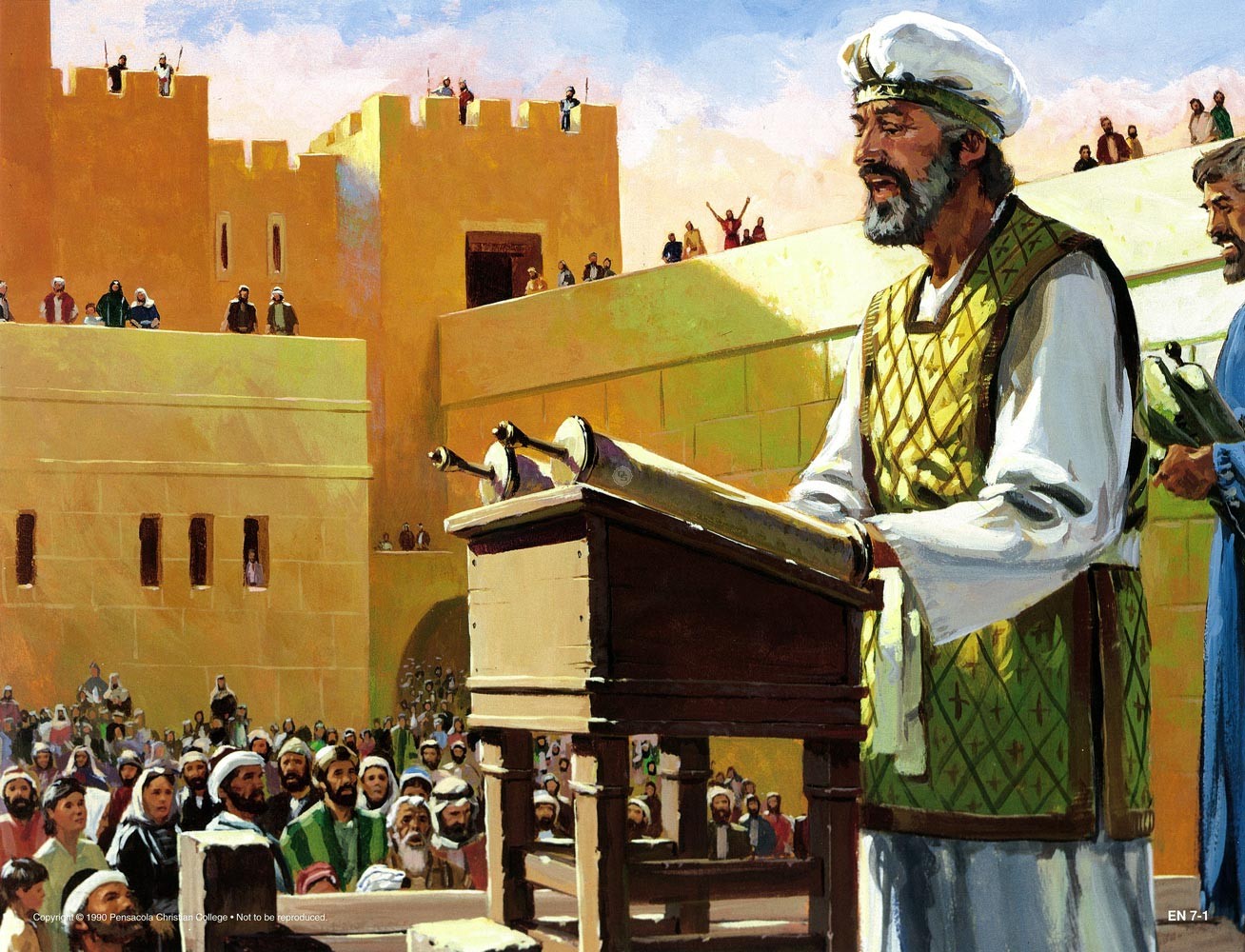
    The Joy of the LORD - The Wall is Dedicated & The Word is Preached!
    The Joy of the LORD – The Wall is Dedicated & The Word is Preached!

    The Joy of the LORD – Celebrate!

    Nehemiah 8:7-12
    7 The Levites—Jeshua, Bani, Sherebiah, Jamin, Akkub, Shabbethai, Hodiah, Maaseiah, Kelita, Azariah, Jozabad, Hanan and Pelaiah—instructed the people in the Law while the people were standing there. 8 They read from the Book of the Law of God, making it clear[a]and giving the meaning so that the people could understand what was being read.
    9 Then Nehemiah the governor, Ezra the priest and scribe, and the Levites who were instructing the people said to them all, “This day is sacred to the Lord your God. Do not mourn or weep.” For all the people had been weeping as they listened to the words of the Law.
    10 Nehemiah said, “Go and enjoy choice food and sweet drinks, and send some to those who have nothing prepared. This day is sacred to our Lord. Do not grieve, for the joy of the Lord is your strength.”
    11 The Levites calmed all the people, saying, “Be still, for this is a sacred day. Do not grieve.”
    12 Then all the people went away to eat and drink, to send portions of food and to celebrate with great joy, because they now understood the words that had been made known to them.

  • They did not know how to respond at first. They knew they were far from God, they did not know the law, they were cut by this realization and then very sad about it – but it was not the response that was needed! It was time to repent and celebrate!
  • Then the leaders encouraged them – repentance is something that refreshes – and they celebrated. Why? A principle – this was a time to celebrate God, and “the joy of the Lord is [our] strength!”
  • The people responded to this admonishment from their leaders – they celebrated GOD.
  • I must do the same, GOD is awesome. He is worthy of praise and worthy of celebration! I need to make sure I celebrate this Christmas with this in mind.
  • There is so much to be grateful for this thanksgiving – God’s true Word and God himself!
  • Consider Jesus’ Joy and Don’t Lose Heart!

    Hebrews 12:3
    “Consider him who endured such opposition from sinful men, so that you will not grow weary and lose heart.”

  • A man who is weary does not have the joy of the LORD, and he loses heart – he lacks enthusiasm. When I get weary, I need to realize that it is because in my sin I rely on flesh for strength! There will be opposition in following Jesus – that’s a fact (2 Tim 3:12)
  • I need more GOD when I feel this way. More prayer, more bible, more faith, more hope! I need to FIX my eyes on JESUS – he is perfect, and the author of my faith.
  • Hebrews 12:2-12
    2 Let us fix our eyes on Jesus, the author and perfecter of our faith, who for the joy set before him endured the cross, scorning its shame, and sat down at the right hand of the throne of God.
    4 In your struggle against sin, you have not yet resisted to the point of shedding your blood. 5 And you have forgotten that word of encouragement that addresses you as sons:
    “My son, do not make light of the Lord’s discipline,
    and do not lose heart when he rebukes you,
    6 because the Lord disciplines those he loves
    and he punishes everyone he accepts as a son.”[a]
    7 Endure hardship as discipline; God is treating you as sons. For what son is not disciplined by his father? 8 If you are not disciplined (and everyone undergoes discipline), then you are illegitimate children and not true sons. 9 Moreover, we have all had human fathers who disciplined us and we respected them for it. How much more should we submit to the Father of our spirits and live! 10 Our fathers disciplined us for a little while as they thought best; but God disciplines us for our good, that we may share in his holiness. 11 No discipline seems pleasant at the time, but painful. Later on, however, it produces a harvest of righteousness and peace for those who have been trained by it.
    12 Therefore, strengthen your feeble arms and weak knees. 13 “Make level paths for your feet,”[b] so that the lame may not be disabled, but rather healed.

  • I am not bleeding here. I am not being so hard pressed that I am in prison or that my blood is being demanded of me from scourging or beatings. And yet, Paul, when under such duress wrote the most joyful book in the scriptures – Philippians! Jesus himself, overcame his sorrow through prayer and more prayer – this is what I must imitate in the LORD and in men like Paul who followed him.
  • Whatever suffering on this road of life, it is at those times that God is disciplining me as his son – a true son! Amen! His goal? I would grow in my holiness – have I not asked God for this almost every single day? He is answering my prayers.
  • I need to pray to be trained by discipline or it will be wasted on me! I’ll either be trained or embittered by hardship!
  • How amazing the scriptures are – “strengthen your[my] feeble arms and weak knees.” It is as if the word of God knows, if you are getting disciplined, you can feel weak and lose motivation (arms for work, knees for legs that go).
  • There is a harvest here – I must get – righteousness, holiness and peace, should I just submit to my Father’s will and learn.
  • I must not let any unresolved issues or hardship control my demeanor, my devotion, my motivation.
  • Train my heart to see the amazing good that has come out of God’s church! “Finally, brothers, whatever is true, whatever is noble, whatever is right, whatever is pure, whatever is lovely, whatever is admirable — if anything is excellent or praiseworthy — think about such things.” – Phil 4:8
  • Learn Obedience, Harvest Peace & Joy

    Jesus learned obedience when he suffered…I am following Jesus, and I will learn obedience in the same way as my brother (Rom 8:29), my LORD (1 Cor 12:3), my King (Rev 17:14), and my Friend (John 15:14).

    Heb 5:7-10
    7 During the days of Jesus’ life on earth, he offered up prayers and petitions with loud cries and tears to the one who could save him from death, and he was heard because of his reverent submission. 8 Although he was a son, he learned obedience from what he suffered 9 and, once made perfect, he became the source of eternal salvation for all who obey him…

    Amen.

    Jeremy Ciaramella
    Jeremy Ciaramella

  • The Fear of The LORD vs. The Fear of Correction

    The Fear of The LORD vs. The Fear of Correction

    The Fear of The LORD is the beginning of knowledge; but fools despise wisdom and discipline - Proverbs 1:7
    The Fear of The LORD is the beginning of knowledge; but fools despise wisdom and discipline – Proverbs 1:7

    “The fear of the LORD is the beginning of knowledge; but fools despise wisdom and discipline.” – Proverbs 1:7

    If I don’t have the fear of the LORD, I will not understand anything about knowing God, I won’t even know where to start.  If I don’t have the fear of the LORD, I will despise wisdom. What does that mean, “wisdom?”  How does one get “wisdom?”
    • Proverbs 1:2, the proverbs help us have wisdom.  Do I want to read them?
    • Prov 2:6, the LORD gives wisdom.  Do I want to ask him?  James 1:5-8
    • Prov 3:13, wisdom is something you actually have to look for, you have to want to look for it.
    • Prov 4:5, wisdom is begotten by obeying God’s word.  Do I want to obey God’s word?
    • Prov 10:13, the lips of the discerning have wisdom.  Do I want to listen?  Do I want discipling?  Do I delight when someone helps me be with my own lacking in wisdom?
         If you think you are a whiz at everything, then you are taking the “wis” out of wisdom. – Jeremy Ciaramella
         Prov 11:2, When pride comes, then comes disgrace, but with humility comes wisdom.
    Being humble is what will bring wisdom.  That’s a sign I have “The Fear the LORD!”
         Do I hate admitting I am wrong?  Do I resent it when someone points out a fault, a mistake, or a sin?  Do I willingly and eagerly confess my sins?  Do I ask people advice about how I am doing things?  Do I seek their advice or do I gush my solution, my perspective, my experiences, my successes, and my opinions?  Do I avoid or dislike apologizing?  Is it hard for me to apologize?  Do I have to wrap their fault into the apology?  “I’m sorry I did that, but if you have not first done what you’d done, I would have never done that to you…”  All of these things are pride.  All of these things are disgraceful.  All of these things show I despise wisdom, because I am not loving humility.  Humility is Christ’s most powerful attribute, it is what led him to the cross for our sake – Phil 2:5-8.  If I don’t have humility, it’s because I don’t have the fear of the LORD.  I’ll not start learning, gaining knowledge, until I have humility.
         Prov 13:10 “Pride only breeds quarrels, but wisdom is found in those to take advice.”
    How can I know I’m pursuing humility?
         Do I seek advice?  Do I get advice intending to actually follow it?  I appreciate disciples who take notes and such when they are getting advice/discipling.  It shows they actually want to recall what they are learning and apply it.  Do I do that?  If I don’t take advice, it’s a sign that I am quarrelsome and prideful.  Am I more eager to give advice to my leaders than to take their advice?  Do I undermine their role because I’m so bent on implying and applying my opinion?  Do I put people on eggshells because I often remind them of the shortcomings in them that I see?  Do I talk more than I listen?  Talking too much, talking loudly, talking over people, interrupting people…all of these things cause quarreling, because they are prideful actions.  These actions demonstrate a lack of wisdom and thus a lack of “The Fear of the LORD.”
         Prov 14:8 “The wisdom of the prudent is to give thought to their ways, but the folly of fools is deception.”
    • Do I understand that a lack of vulnerability is the same as deception?  “To love at all is to be vulnerable. Love anything, and your heart will certainly be wrung and possibly be broken.” – CS Lewis, “The Four Loves”
    • This is because mistrust the same as being unloving.  We fear the error of man more than we seek the divine nature of God’s love.
    • If I don’t have “The Fear of the LORD,” I will despise discipline.  I’ll resent correction.  I’ll fear admonishment, rebuke, and correction.  I’ll resent those that deliver it, and rationalize avoiding them and opening up to them.  I’ll not accept rebuke and instead will seek to dismantle it and merely endure it instead of be changed from it.
    Wisdom pours her heart out to those who accept her rebuke. (Prov 1:23-25)
    • When I spurn a rebuke, I prove that I am scheming, wayward, and prepped for destruction…(Prov 1:29-33)
    • Do I hate it when someone who corrects me or do I love it/them?  If I’ve stopped trusting them, then I’ve stopped loving them, and that is hateful. (1 Cor 13:4-8, “love always trusts.“) Prov 9:8.
    • Do I have a biblical understanding of the value and power of someone showing “sharp disapproval or criticism” because of my “behavior or actions?” (Definition of rebuke = “Express sharp disapproval or criticism  of (someone) because of their actions or behavior.“)
    • Do I understand the impact of listening to a rebuke?
      • It makes me a wise son, Prov 13:1
      • It makes me at home among the wise, Prov 15:31
      • It should impress me if I am a man of discernment, Prov 17:10
      • It will cause me to gain knowledge if I am discerning, Prov 19:25
      • It will give me spiritual wealth (golden earring), Prov 25:12
      • It shows me that someone openly loves me, Prov 27:5
    • Older men you are not to rebuke harshly!  You are still rebuke to them, just not harshly!  Exhort them as fathers! 1 Tim 5:1
    • We are to both rebuke AND encourage!  And do both with GREAT patience and CAREFUL instruction.  Am I CAREFUL in my rebuke AND in my encouragement?  2 Tim 4:2
    • Titus 1:10-14 this kind of heart must be rebuked SHARPLY.  A SHARP “sharp disapproval or criticism” is for these people because they are (a) rebellious & deceiving others in Titus 1:10, (b) ruining whole households with their teaching(s), and (c) they are liars, brutes, and lazy gluttons.  The solution to people acting like this is a SHARP rebuke – with goal being that they would be sound in the faith and not pay any attention to false doctrines and myths.  We cannot be “sound in the faith” if we do no have “The Fear of The LORD!”
    • A rebuke from the evangelist, the church overseer, is done with all authority!  The same guideline is given for encouragement.  Titus 2:15.  No one in the church is allowed to despise the church leader.  In principle then, no one should despise their house church leader or their bible talk leader.  No one in the group God assigned gave you to lead is permitted to despise you according to this scripture.  And it’s up to you to make sure that is the case!  It is our goal that all our dear brothers and sisters would have “The Fear of The LORD!”

    Jesus made a whip out of chords..
    Jesus made a whip out of chords..

    Jesus rebuked those he loved and disciplined.  (cf. Rev 3:19).  Am I being like Jesus and rebuking those that I love? (cf. Proverbs 27:5)  Am I striving for the FEAR of the LORD and helping those around me to do the same?  Or is there a fear (or hatred) of correction? (cf. Proverbs 12:1)

    Jeremy Ciaramella
    Jeremy Ciaramella


  • The Order of Melchizedek

    The Order of Melchizedek

    Abraham Meets Melchizedek
    Abraham Meets Melchizedek

    “After Abram returned from defeating Kedorlaomer and the kings allied with him, the king of Sodom came out to meet him in the Valley of Shaveh (that is, the King’s Valley). Then Melchizedek king of Salem brought out bread and wine. He was priest of God Most High, 19 and he blessed Abram, saying,
    ‘Blessed be Abram by God Most High,
    Creator of heaven and earth.
    And blessed be God Most High,
    who delivered your enemies into your hand.’
    Then Abram gave him a tenth of everything.”
    Gen 14:17-20(NIV84)

    What an interesting person Melchizedek is in the scriptures!  Abram heard about his nephew Lot being captured by the enemies of the Kings whose lands he’d decided to settle in. With 318 men, Abram pursued these enemies (“Kedorlaomer and the kings allied with him“), overtook them, and routed them to rescue his nephew Lot and incidentally also rescued food, supplies and people who were from Sodom.  After the above blessing from the “King of Salem” (which also means, “King of Peace”) Abraham refuses any reward from the wicked King of Sodom and goes on his way and there are no other interactions recorded in the scriptures with Melchizedek.  Melchizedek’s significance remained unknown for about two thousands years, save for what one could deduce from this interaction with Abram and what these scriptures say about him.

    Richard Harris as Abraham - (c. 1993)
    Richard Harris as Abraham – (c. 1993)

    At this point in God’s relationship with man, there was no priestly covenant, there were not yet twelve tribes, and thus there were no “Levites” to serve as priests of the one true God.  It is understood in Hebrew tradition that when we are blessed by someone, the greater blesses the lesser.  It is also peculiar that the scriptures make it a point to note that he brought out bread and wine.  The most interesting thing here is the bible’s assertion that Melchizedek “was priest of God Most High.”  This is a validation of priesthood outside of Aaron’s descendants and there is no one else like Melchizedek who was noted as a priest of God Most High in the entire Torah – the “Old Testament.”

    The book of Hebrews, addressing it’s eponymous audience, clarifies exactly what is going on here in Genesis 14 between Abram and Melchizedek.  The Hebrews author crystallizes his significance to any one of us who’d strive to call on the name of the Lord Jesus Christ.  To a Hebrew, the Levitical Priesthood was at the center of life and worship.  The thought of anyone not of the priestly tribe offering sacrifices to God or laying claim to priesthood before Jehovah-God was not only offensive, but punishable by death according to the scriptures.  There are several accounts in the scriptures of the sudden death of those who’d dare come and perform duties prescribed to only Aaron’s sons.  For someone to lay claim to being a priest who was not of Aaron’s line was blasphemous.

    This is what makes the following passage powerfully inspiring to some and grossly offensive to others:
    But you are a chosen people, a royal priesthood, a holy nation, a people belonging to God, that you may declare the praises of him who called you out of darkness into his wonderful light.” 1 Peter 2:9

    Peter taught that disciples of Jesus were now a part of a Royal Priesthood.  1 Peter begins clarifying that the epistle addresses disciples of Jesus who are “…God’s elect, strangers in the world, scattered throughout Pontus, Galatia, Cappadocia, Asia and Bithynia…” 1 Peter 1:2.  What a radical thought – that I am a Royal Priest as a disciple of Jesus!  The book of Hebrews explains how this is by illuminating what happened in Genesis 14 between Abram and Melchizedek.

    Heb 5:1-6
    1 Every high priest is selected from among men and is appointed to represent them in matters related to God, to offer gifts and sacrifices for sins. 2 He is able to deal gently with those who are ignorant and are going astray, since he himself is subject to weakness. 3 This is why he has to offer sacrifices for his own sins, as well as for the sins of the people.
    4 No one takes this honor upon himself; he must be called by God, just as Aaron was. 5 So Christ also did not take upon himself the glory of becoming a high priest. But God said to him,
    “You are my Son; today I have become your Father.”
    6 And he says in another place,
    “You are a priest forever, in the order of Melchizedek.”

    This is clarifying in that Jesus was a “priest forever, in the order of Melchizedek.”  This reference is from the prophetic Psalm 110 verse 4.  Not only was Jesus a priest in the order of Melchizedek, but the high priest.  “Although he was a son, he learned obedience from what he suffered 9 and, once made perfect, he became the source of eternal salvation for all who obey him 10 and was designated by God to be high priest in the order of Melchizedek.” Heb 5:8-10  We learn here that in the new covenant, Jesus Christ is our high priest.  It gets even deeper that that though!  Later in Hebrews we learn that Jesus entered the very sanctuary of God – not the physical copy on earth in the temple or tent of the meeting, but the actual heavenly sanctuary on our behalf.

    Heb 6:17-20
    17 Because God wanted to make the unchanging nature of his purpose very clear to the heirs of what was promised, he confirmed it with an oath. 18 God did this so that, by two unchangeable things in which it is impossible for God to lie, we who have fled to take hold of the hope offered to us may be greatly encouraged. 19 We have this hope as an anchor for the soul, firm and secure. It enters the inner sanctuary behind the curtain, 20 where Jesus, who went before us, has entered on our behalf. He has become a high priest forever, in the order of Melchizedek.

    What anchors my soul?  What do I hope in?  That my circumstances will improve?  That I’ll be successful in something?  What am I “greatly encouraged” by?  Atonement in the old covenant for sins was accomplished outwardly by the priest entering the most holy place (a copy of the actual one in heaven) and offering a sacrifice on behalf of the people of God.  Do I understand that Jesus went into the actual “most holy place” in the heavenly realm and offered himself, his own blood shed on the cross, for my sake – to make atonement for my sins?

    The interaction in Genesis 14 between Abram and Melchizedek is brought to light here:
    Heb 7:1-10
    This Melchizedek was king of Salem and priest of God Most High. He met Abraham returning from the defeat of the kings and blessed him, 2 and Abraham gave him a tenth of everything. First, his name means “king of righteousness”; then also, “king of Salem” means “king of peace.” 3 Without father or mother, without genealogy, without beginning of days or end of life, like the Son of God he remains a priest forever.

    4 Just think how great he was: Even the patriarch Abraham gave him a tenth of the plunder! 5 Now the law requires the descendants of Levi who become priests to collect a tenth from the people — that is, their brothers — even though their brothers are descended from Abraham. 6 This man, however, did not trace his descent from Levi, yet he collected a tenth from Abraham and blessed him who had the promises. 7 And without doubt the lesser person is blessed by the greater. 8 In the one case, the tenth is collected by men who die; but in the other case, by him who is declared to be living. 9 One might even say that Levi, who collects the tenth, paid the tenth through Abraham, 10 because when Melchizedek met Abraham, Levi was still in the body of his ancestor.

    When Christ came as high priest of the good things that are already here, he went through the greater and more perfect tabernacle that is not man-made, that is to say, not a part of this creation. 12 He did not enter by means of the blood of goats and calves; but he entered the Most Holy Place once for all by his own blood, having obtained eternal redemption. - Heb 9:11-12
    When Christ came as high priest of the good things that are already here, he went through the greater and more perfect tabernacle that is not man-made, that is to say, not a part of this creation. He did not enter by means of the blood of goats and calves; but he entered the Most Holy Place once for all by his own blood, having obtained eternal redemption. – Heb 9:11-12

    The concept of tithing did not originate from the Levitical priesthood.  The concept of tithing came from Abram’s response to Melchizedek as he recognized him as a priest of God Most High.  Abraham gave him a tenth of everything.  It’s no wonder that as disciples of Jesus, we too offer a tenth of everything to our Lord, Jesus Christ, as he is the eternal high priest in the Order of Melchizedek.  It’s strange to me that we’d quarrel or contend with the teaching of giving a 10th of everything seeing as our Lord is in the Order of Melchizedek.

    If he is the eternal High Priest, then 1 Peter 2:9 is no longer offensive – we understand that we too are priests in the same order.  There was the order of Aaron, the Levitical priesthood, and it could not bring perfection.

    Tithing in the Order of Melchizedek
    Tithing in the Order of Melchizedek

    Heb 7:11-16
    11 If perfection could have been attained through the Levitical priesthood (for on the basis of it the law was given to the people), why was there still need for another priest to come — one in the order of Melchizedek, not in the order of Aaron? 12 For when there is a change of the priesthood, there must also be a change of the law. 13 He of whom these things are said belonged to a different tribe, and no one from that tribe has ever served at the altar. 14 For it is clear that our Lord descended from Judah, and in regard to that tribe Moses said nothing about priests. 15 And what we have said is even more clear if another priest like Melchizedek appears, 16 one who has become a priest not on the basis of a regulation as to his ancestry but on the basis of the power of an indestructible life.

    There is that eternal hope, there is than anchor for the soul, Jesus Christ’s life was indestructible!  The priesthood changed and thus the law changed.  What cemented Jesus’ high priesthood was his resurrection from the dead.

    Heb 7:23-28
    23 Now there have been many of those priests, since death prevented them from continuing in office; 24 but because Jesus lives forever, he has a permanent priesthood. 25 Therefore he is able to save completely those who come to God through him, because he always lives to intercede for them.

    26 Such a high priest meets our need — one who is holy, blameless, pure, set apart from sinners, exalted above the heavens. 27 Unlike the other high priests, he does not need to offer sacrifices day after day, first for his own sins, and then for the sins of the people. He sacrificed for their sins once for all when he offered himself. 28 For the law appoints as high priests men who are weak; but the oath, which came after the law, appointed the Son, who has been made perfect forever.

    In the old covenant, only the priest could enter the most Holy Place to intimately commune with God.  He could also only come into this most Holy Place with blood from a sacrifice for his sins and the people’s sins.  There was no deep connection with God.  With Jesus as our high priest – this changes everything.

    Heb 10:3-4 But those sacrifices are an annual reminder of sins, 4 because it is impossible for the blood of bulls and goats to take away sins.
    Heb 10:3-4
    But those sacrifices are an annual reminder of sins, 4 because it is impossible for the blood of bulls and goats to take away sins.

    Heb 10:11-14
    11 Day after day every priest stands and performs his religious duties; again and again he offers the same sacrifices, which can never take away sins. 12 But when this priest had offered for all time one sacrifice for sins, he sat down at the right hand of God. 13 Since that time he waits for his enemies to be made his footstool, 14 because by one sacrifice he has made perfect forever those who are being made holy.

    Heb 10:19-25
    19 Therefore, brothers, since we have confidence to enter the Most Holy Place by the blood of Jesus, 20 by a new and living way opened for us through the curtain, that is, his body, 21 and since we have a great priest over the house of God, 22 let us draw near to God with a sincere heart in full assurance of faith, having our hearts sprinkled to cleanse us from a guilty conscience and having our bodies washed with pure water. 23 Let us hold unswervingly to the hope we profess, for he who promised is faithful. 24 And let us consider how we may spur one another on toward love and good deeds. 25 Let us not give up meeting together, as some are in the habit of doing, but let us encourage one another — and all the more as you see the Day approaching.

    We enter the most holy place by the blood of Jesus Christ himself.  When was the last time I’d considered my quiet time as “entering the most Holy Place” (aka “The Holy of Holies”), the very presence of God, as a “royal priest” in the order of Melchizedek?  Do I have confidence in drawing towards God?  The role of the priest in the Levitical priesthood was to intercede for the people and God through the prescribed sacrifices and cleansing rituals.  As a royal priest in the order of Melchizedek, with Jesus Christ as our eternal high priest, our role is to be committed to the message of reconciliation.  God makes his appeal through us!  Is he able to make that appeal through me, or am I squelching his Spirit because I am taking for granted the hope I profess?  What do I need to get open about so my heart can be sprinkled and cleansed by the blood of Christ?  “But if we walk in the light, as he is in the light, we have fellowship with one another, and the blood of Jesus, his Son, purifies us from all sin.” – 1 John 1:7 Have I been committed to the message of reconciliation, serving as a royal priest in the Kingdom of God in the order of Melchizedek to a lost world – just like my Lord and Savior Jesus Christ? It’s time to get open and get close to God (James 5:16). Pray and realize that in that prayer, you are in the spiritual holy of holies, and be confident in your God and in the blood of Christ. Amen.